Skip to content
Home / Products / KAI-Hydro
Product

KAI-Hydro: flood trigger design and flood forecasting

Flood triggers an insurer can price, design floods with their uncertainty, and daily forecasts that end in a plain Normal, Watch or Warning.

KAI-Hydro: Flood and drought forecasts with a plain answer

KAI-Hydro software

Flood and drought forecasts with a plain answer

Floods and droughts rarely come without warning; the warning just arrives in the wrong form, or too late. And where there is no river gauge, nobody can say how big a 1-in-10-year flood is, so flood cover is hard to price and engineers design on one number from an old study.

KAI-Hydro answers both questions. For insurers and engineers it moves your site onto the river, pulls 40+ years of the GloFAS v5 global flood reanalysis, fits the flood-frequency curve with uncertainty bands, designs parametric triggers four ways and back-tests each against gauges, year by year: hits, misses and false payouts. For districts and agencies it runs a calibrated basin model every day and turns it into a plain statement: today's level, the expected peak and its date, and a status of Normal, Watch or Warning, with alerts by email or SMS.

For humanitarian programmes, we design and back-test anticipatory-action triggers and run the forecast that fires them. The result: triggers whose basis risk is known before money depends on them, and days of lead time instead of hours.

Why choose KAI-Hydro

Why choose KAI-Hydro?

Triggers and forecasts that end in a decision, tested on past years before you rely on them.

  • Triggers you can price. Back-tested year by year: hits, misses and false payouts
  • Basis risk shown, not hidden. Global model checked against gauges before it goes into a contract
  • Design floods with bands. 1-in-10 to 1-in-200-year flows with their uncertainty
  • Plain answers each day. Normal, Watch or Warning, with the expected peak and date
  • Skill reported. Monthly verification against observed levels
Trigger explorer: GloFAS against 14 gauges
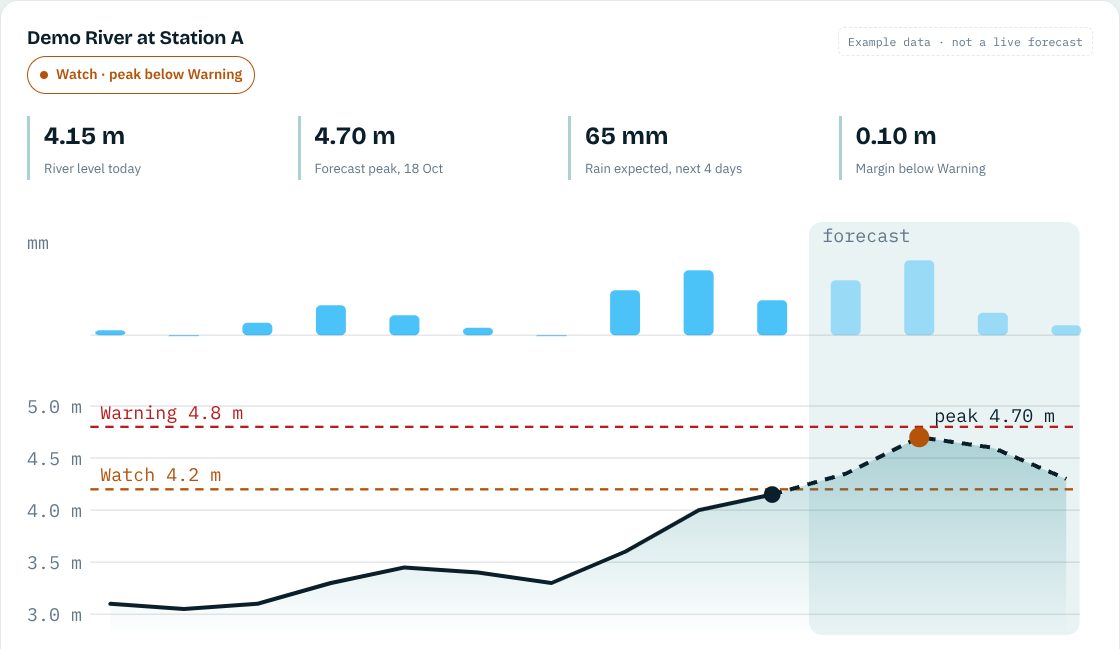
Daily outlook with thresholds
Workflow

KAI-Hydro workflow

A step-by-step guide from your data to a result you can act on.

  1. Site

    Your location, asset or river reach; the cover or decision you need.

  2. Snap

    The site is moved onto the river by catchment size; small streams are flagged.

  3. Flood history

    40+ years of daily flow from GloFAS v5, plus any gauge you hold.

  4. Return levels

    GEV and Log-Pearson III with 90 % bands; levels beyond the record flagged.

  5. Triggers

    Four methods, attachment and exhaustion, back-tested on past years.

  6. Operate

    Daily forecasts and alerts, and the trigger watched in the season.

Key features

Key features of KAI-Hydro

  • Trigger design. Fixed value, percentile, return period or share of a reference flood
  • Back-test report. Hits, misses and false payouts for every method
  • Design floods. Return levels with bands, checksummed and versioned
  • Five-day river forecast. Level, peak and timing at each forecast point
  • Status in plain words. Normal, Watch or Warning, with email and SMS alerts
  • Anticipatory action. Back-tested triggers and a duty forecaster in the season (Premium)
Which years the trigger paid
New · GloFAS 5.0 · parametric insurance · reference case on real data

Parametric flood trigger design, on GloFAS 5.0, tested before you sell it

A parametric policy pays when the river index crosses the trigger. We set triggers from the global flood model where no gauge exists, then score them against real gauges, year by year, so the basis risk is known before a policy is written. Now on GloFAS 5.0, which sees these floods at their real size.

River gauges tested14Guadalquivir, Spain · water years 1985–2022
GloFAS 5.0 10-year flood105 %of the gauged size (median) · GloFAS 4.0: 22 %
Trigger as the model's 1-in-533 of 60flood years paid · 34 false payouts · 4.0: 30 · 27
Trigger in m³/s26 of 60flood years paid · 30 false payouts · 4.0: 6 · 10

Same 286 gauge-years (1998–2022) for both model versions, so the difference is the model. GloFAS 5.0 over all its years (1985–2022): 53 of 89 flood years paid as a return period, 41 in m³/s.

Step 1 · choose your forecast point

Where do you need a trigger?

Switch between map, light and satellite views. Tap a reference gauge to see how a trigger would have done there, or tap any river to pin your own point.

Pick a forecast point

Tap a reference gauge to load it into the explorer below, or tap any river to pin your own forecast point.

  • Gauge: big years match (0.6+)
  • 0.3 to 0.6
  • below 0.3
  • GloFAS river cell (5 km)
  • Sub-catchments draining to the chosen gauge
  • Your forecast point

Basemaps: OpenFreeMap (OpenStreetMap) and Esri World Imagery. Rivers, lakes and boundaries: OpenStreetMap. Sub-catchments: HydroBASINS level 8 (WWF, Lehner and Grill 2013).

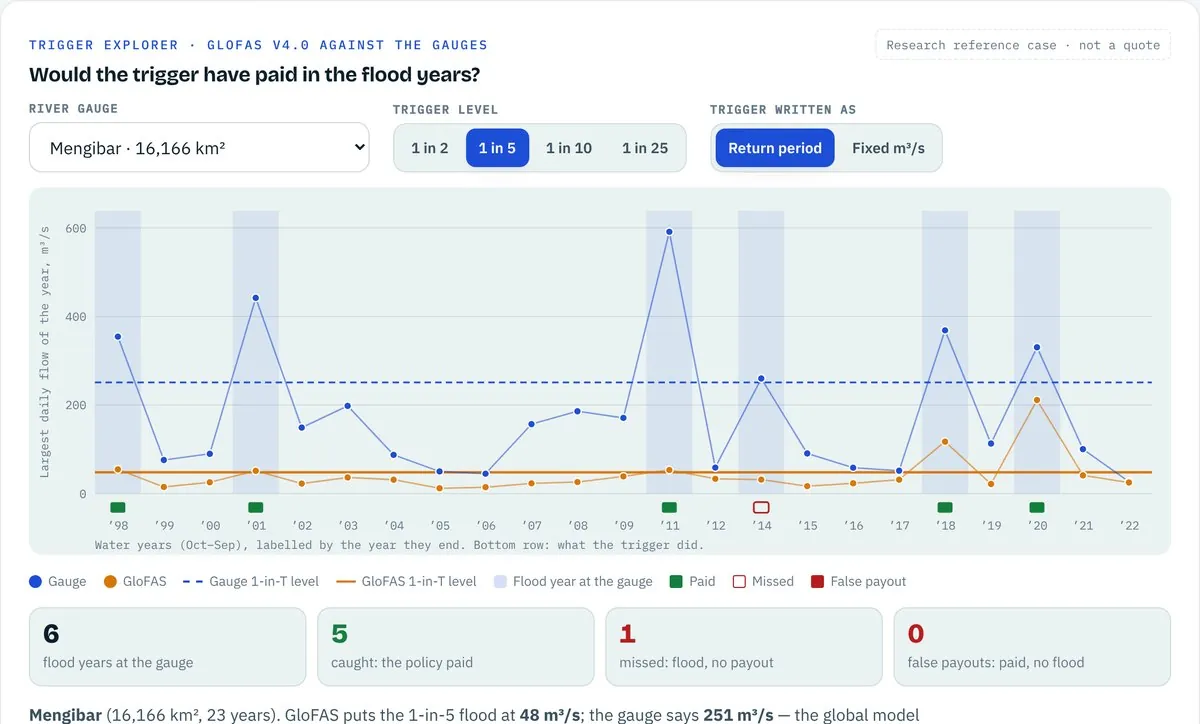
Trigger explorer · GloFAS against the gauges

Would the trigger have paid in the flood years?

Research reference case · not a quote
Trigger level
Trigger written as
–
flood years at the gauge
–
caught: the policy paid
–
missed: flood, no payout
–
false payouts: paid, no flood

Loading the reference case…

What the reference case shows

  • GloFAS 4.0 runs low here. In this dammed, semi-arid basin it sees floods at about 22 % of their gauged size, so a trigger written in m³/s caught 6 flood years, against 30 as the model's own return period.
  • GloFAS 5.0 fixes most of the bias. On the same years its 10-year flood is 105 % of the gauged one, and the m³/s trigger catches 26 of 60. Written as the model's own return period it still catches more (33), so that remains the safer way.
  • Basis risk is still too high to sell on the global model alone (about half of payouts fall in years without a flood with both versions; year-to-year agreement 0.55 with 5.0). KAI calibrates each trigger on a gauge, satellite flood maps or local records before it goes into a contract.
  • Explorer data: GloFAS 5.0 by default; switch to 4.0 above to see the first test. The side-by-side comparison is in the case.

Read the full case, with interactive charts →

Four ways to write a trigger

  1. Fixed value. Pays above a set flow, e.g. 450 m³/s. Simple, but carries the model's bias.
  2. Percentile. Pays above the model's own 95th or 99th percentile flow.
  3. Return period. Pays above the model's own 1-in-T-year flood, with the T agreed in the policy.
  4. Share of a reference flood. Pays above a share of a named past flood, e.g. 80 % of the 2010 peak.

Each comes with an attachment level (payout starts) and an exhaustion level (full payout). The same flood-frequency study gives engineers design floods with their uncertainty bands.

Work package · KAI-Hydro Professional

This study, for your sites

Everything in this reference case, run on GloFAS 5.0 for up to five sites of your choice, gauged or not, and kept current when the model is upgraded.

  1. Site and riverEach site moved onto the river by catchment size; small streams flagged for a local study.
  2. Flood history40+ years of daily flow from GloFAS 5.0 at each site, plus any gauge or records you hold.
  3. Return levels1-in-2 to 1-in-200-year floods with 90 % bands; beyond the record flagged.
  4. Trigger designWritten four ways, with attachment and exhaustion levels: a payout band, not a single line.
  5. Back-testEvery year: flood years paid, missed, and payouts without a flood.
  6. Basis-risk scoreHow well the model ranks your real floods, checked against your local evidence.
  7. Trigger sheetOne page per site, ready for the term sheet, with a method note and the data files.
  8. Kept currentEach trigger re-tested when GloFAS is upgraded, as here from 4.0 to 5.0.
Professional planUp to 5 sites · design floods for engineers from the same study · programmes and many basins on the Anticipatory Action plan
The full Guadalquivir caseFive interactive charts: the 10-year flood at every gauge, flood-frequency curves with their bands, the trigger year by year, all gauges pooled, and basis risk.Open the case study →
Live demo

What a client sees each morning

Observed rainfall and river levels with a five-day outlook, then a plain statement of whether action is needed. The river below is a made-up example.

Demo River at Station A

Watch
Example data · not a live forecast
DateRain mmLevel mStatus
Create it, customise it, own it

Your own KAI-Hydro workspace

Create an account, customise the product to your operation and own it for daily work. KAI runs everything behind it: storage and database, the knowledge base, and the software that schedules and runs your model jobs. The front end is yours from day one.

You runDashboards · maps · alerts · reports · your users
KAI runsDatabase and storageKnowledge baseJob and workflow orchestration
KAI engineCalibrated models for water and energy, tested on real data
One account for every KAI product. Free to start.
  • Your account, your product

    Open a free account, pick the product and switch it on. Your sites, users, thresholds and layers are set up for you, and the front end is ready the same day.

  • Customised, then yours to run

    We shape the product to your operation: the points you watch, the reports you file, the alerts your team needs. Your team runs it every day; your data stays yours and exports at any time.

  • Storage and database, handled

    Time series, maps, logs, models and files kept in one managed database, backed up, secured per user and shared only as you decide.

  • A knowledge base that grows

    Your reports, methods, data sources and model documentation in one searchable place, so a new engineer finds why a number is what it is.

  • Workflows that run themselves

    Model runs, data pulls, quality checks and alerts are scheduled and queued for you, every day, with a log of each run.

  • A team on call

    We keep the models calibrated, add data as it arrives and answer within two working days. You get a modelling team without hiring one.

Pricing

KAI-Hydro plans

Start free. Move up a tier when it pays for itself. Paid plans are invoiced; pay by bank transfer or mobile money.

Free

Outlook

Free

See how a KAI-Hydro forecast reads.

  • Interactive demo forecast
  • Seasonal rain and drought notes
  • Product updates by email
Start free
Starter

Basin

$190per month

Daily forecasts for one river site.

  • Daily 5-day forecast for one site
  • Watch and Warning levels set with you
  • Email alerts when a level is forecast
  • Monthly forecast-skill summary
Choose Basin
ProfessionalMost chosen

Professional

$590per month

Trigger studies and a forecast network for a basin or a district.

  • Parametric flood trigger study for up to 5 sites on GloFAS 5.0: payout band, back-test, basis-risk score
  • Up to 5 forecast points
  • SMS and email alerts
  • Seasonal drought outlook
  • Verification report every month
Choose Professional
Premium

Anticipatory Action

Custompriced with you

Triggers that release funds before the flood.

  • Trigger design and back-testing
  • Several basins and partner systems
  • Duty forecaster in the rainy season
  • Support for anticipatory-action protocols
Request a quote

Prices in US dollars, excluding VAT. Annual plans: pay for 10 months, get 12. Compare all plans · Login

Interested?

Interested in KAI-Hydro?

Contact our team today for a demo on your own data, or start free now.

Guides

Guides on this topic

All KAI guides

Questions

KAI-Hydro: questions and answers

What does KAI-Hydro answer?

Will the river reach a dangerous level in the next days, and how often would a flood trigger have paid? KAI-Hydro gives daily forecasts with Watch and Warning levels set with you, alerts by email or SMS, seasonal drought outlooks, and parametric trigger studies on GloFAS 5.0 with a payout band, back-test and basis-risk score.

Who is KAI-Hydro for?

Teams who must act before a flood: district disaster teams, humanitarian programmes running anticipatory action, and anyone designing a trigger that releases money before the water rises. A single river site can start on the Basin plan.

How good are the GloFAS flood triggers?

We tested them on 14 Spanish river gauges (286 gauge-years, 1998–2022). GloFAS 4.0 saw floods at about a fifth of their measured size, so a trigger set in m³/s would have paid in 6 of 60 flood years; GloFAS 5.0 removes most of that bias (26 of 60). How the trigger is written matters as much as the model: see the Guadalquivir case.

What data do you need from me?

The river sites you care about. If you have a gauge record (daily levels or flows as CSV) we use it to set and check the levels; without one, the forecast runs on the global GloFAS river flows and we say so.

All KAI-Hydro questions →