 KAI-Subsurface: well log interpretation, rock typing and geomodels
Rock properties carried from the core plug to the reservoir: well-log interpretation, rock typing, geomodels and property prediction between wells, at a fixed price per well, with the uncertainty stated.
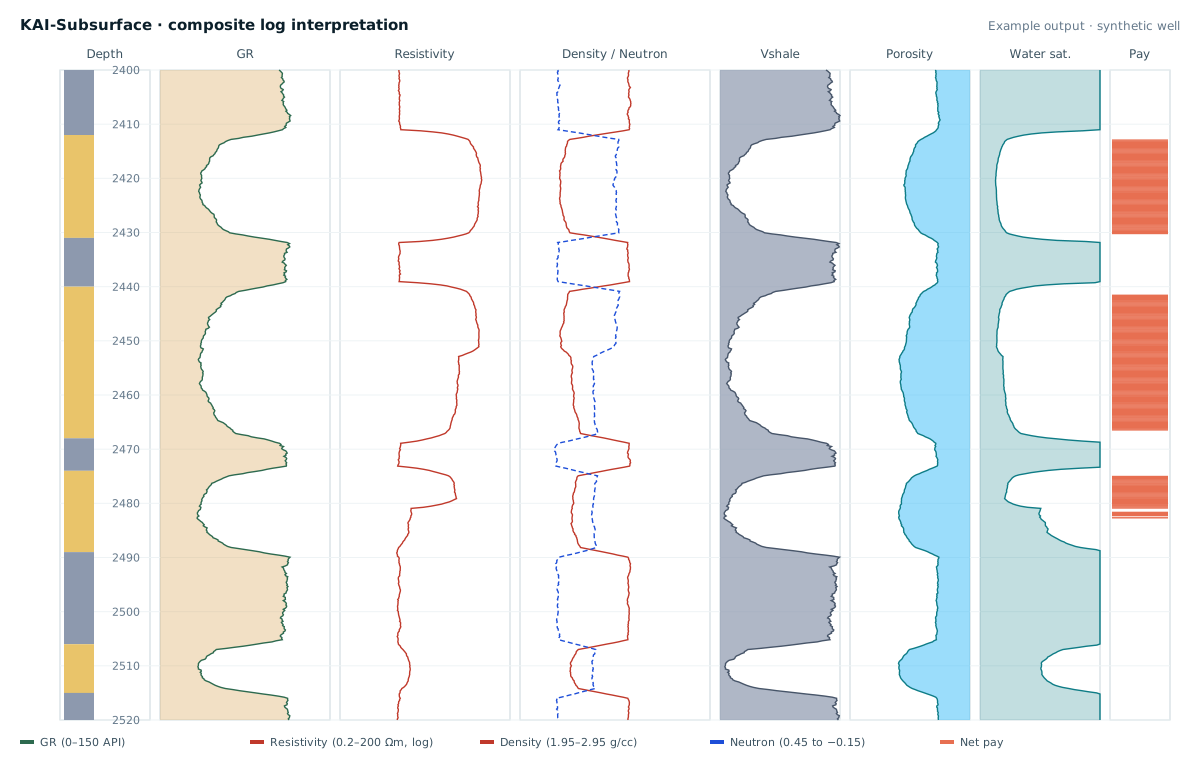
KAI-Subsurface software
Well-log interpretation, geomodels and AI property prediction
Wells are drilled and logged, then wait. Interpretation queues hold up completion, appraisal and investment decisions, and field studies that tie wells together take months.
KAI-Subsurface turns raw logs into answers at a fixed price per well. Every job starts with log quality control and depth matching; quick-looks deliver shale volume, porosity, water saturation and net pay in five working days; full interpretations add multi-mineral petrophysics, facies and calibration to core and tests.
For a field, KAI-Subsurface works across the scales. Rock types from core predict permeability where there is no core; bedding models calibrated on the plugs show how the bed really flows; facies ensembles conditioned on every log carry it between the wells, with the chance of good rock anywhere. The full-field model honours every well and keeps the layers that control flow, instead of averaging them away. It serves geothermal, CO₂ and hydrogen storage, and oil and gas projects anywhere, delivered remotely into your own workspace.
Why choose KAI-Subsurface?
Interpretation without the queue, at a price you know before you start.
- Fixed price per well. Quick-look or full interpretation, priced up front
- Fast. Quick-looks in 5 working days
- Calibrated. Core and test data used wherever they exist
- Plug to reservoir. Core, bed, between-well and field scales in one workflow, uncertainty carried through
- Free first step. A free quality check of one well's logs
KAI-Subsurface workflow
A step-by-step guide from your data to a result you can act on.
Upload
Send LAS files, deviation surveys and any core or test data.
Quality control
Logs checked, depth-matched, edited and documented.
Interpretation
Shale volume, porosity, water saturation, lithology.
Calibration
Against core, pressure and test results.
Net pay
Cut-offs, averages and uncertainty.
Field model
Correlation, geomodel and AI property prediction (Field study).
Delivery
Log plots, tables, digital curves and a report.
Key features of KAI-Subsurface
- Log QC and editing. Gaps, spikes, depth shifts and washouts flagged and fixed
- Petrophysics. Shale volume, porosity, saturation, multi-mineral models
- Facies and net pay. Electrofacies, cut-offs, sums and averages
- Core calibration. Porosity, permeability and saturation tied to core
- Rock typing. Flow zone indicator rock types and permeability for uncored wells, tested blind
- Geomodelling. Well correlation, surfaces and property models
- Between-well ensembles. Process-based facies realisations conditioned on every log, tested blind (Heterogeneity Lab)
- Bed-scale upscaling. Bedding models calibrated on plugs and upscaled by flow (Plug-to-Block Lab)
- AI property prediction. Machine-learning prediction of properties between wells
- Energy transition ready. Geothermal and CO₂ storage reservoirs as well as oil and gas
From the core plug to the reservoir, without losing what controls flow
Flow underground is decided by structures smaller than a log can see and larger than a core can hold. Most models average them away. KAI carries each property up the scales, from the plug to the bed, the ground between the wells and the whole reservoir, with process-based models of how the sediment was laid down, and keeps the uncertainty at every step. The two labs let you try the first steps in a browser.
- cmCore plug
Quality-controlled core, rock types and permeability for uncored wells, tested blind.
Zeerijp-3A case → - cm–mBed
Bedding models calibrated on the plugs, upscaled by flow: which sample gives a vertical permeability you can trust.
Plug-to-Block Lab → - m–kmBetween wells
Facies ensembles conditioned on every log: the chance of good rock anywhere, and what a simplified model costs in flow.
Heterogeneity Lab → - kmReservoir
The site model with flow, heat and stress simulated for each injection or production plan.
Reservoir Lab → - yearsOver time
A digital twin: the ensemble updated as monitoring data arrive, so forecasts of pressure, temperature and ground motion stay current.
The solution →
Rock typing and permeability on real Groningen core
Before KAI-Subsurface works on a client's wells, its methods are tested in the open. Well Zeerijp-3A was cored over 200 m of Rotliegend sandstone in the Groningen gas field; its core analysis and logs are public on NLOG, the Dutch subsurface portal.
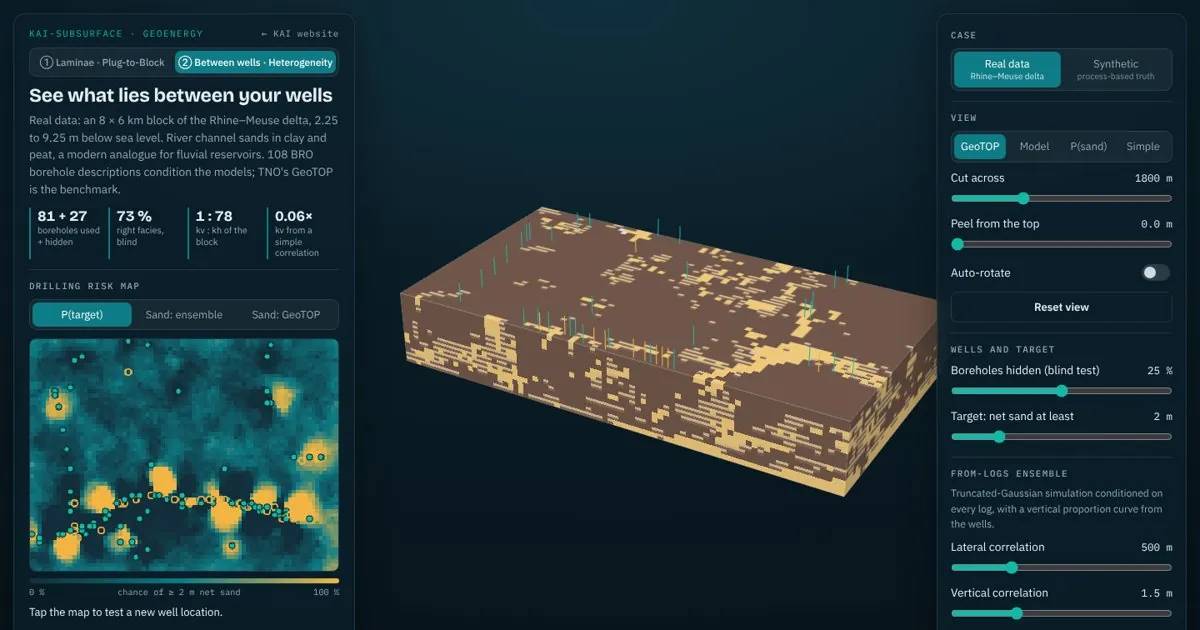 New · two labs, one workflow · in your browserFrom the core plug to the fieldThe Plug-to-Block Lab upscales laminated bedding and says which sample gives a vertical permeability you can trust. The Heterogeneity Lab carries those values between the wells: ensembles conditioned on every log, the chance of hitting good rock anywhere, and what a simplified model costs in flow, tested blind on 108 public Dutch boreholes against TNO's GeoTOP.① Plug-to-Block Lab → ② Heterogeneity Lab → ③ Reservoir Lab → For water wells: drilling odds →
Data: NAM / NLOG (public under the Dutch Mining Act), fetched from NLOG and checksum-verified. Methods: flow zone indicator rock typing, leave-one-core-out blind test, random-forest log model.
Your own KAI-Subsurface workspace
Create an account, customise the product to your operation and own it for daily work. KAI runs everything behind it: storage and database, the knowledge base, and the software that schedules and runs your model jobs. The front end is yours from day one.
Your account, your product
Open a free account, pick the product and switch it on. Your sites, users, thresholds and layers are set up for you, and the front end is ready the same day.
Customised, then yours to run
We shape the product to your operation: the points you watch, the reports you file, the alerts your team needs. Your team runs it every day; your data stays yours and exports at any time.
Storage and database, handled
Time series, maps, logs, models and files kept in one managed database, backed up, secured per user and shared only as you decide.
A knowledge base that grows
Your reports, methods, data sources and model documentation in one searchable place, so a new engineer finds why a number is what it is.
Workflows that run themselves
Model runs, data pulls, quality checks and alerts are scheduled and queued for you, every day, with a log of each run.
A team on call
We keep the models calibrated, add data as it arrives and answer within two working days. You get a modelling team without hiring one.
KAI-Subsurface plans
Start free. Move up a tier when it pays for itself. Paid plans are invoiced; pay by bank transfer or mobile money.
Log QC
Send one well; get a quality check back.
- Quality check of one well's logs (LAS)
- Gaps, spikes and depth-shift flags
- Short note on what an interpretation would add
Quick-look
Fast answers for one well.
- Shale volume, porosity and water saturation
- Net reservoir and pay flags
- Composite log plot
- Delivered in 5 working days
Full interpretation
A complete petrophysical interpretation.
- Multi-mineral petrophysics and facies
- Core and test calibration
- Net pay, averages and uncertainty
- Report and digital deliverables
Field study
From wells to a 3D field model.
- Multi-well interpretation and correlation
- Geomodel and property modelling
- AI property prediction between wells
- Reservoir characterisation report
Prices in US dollars, excluding VAT. Annual plans: pay for 10 months, get 12. Compare all plans · Login
Interested in KAI-Subsurface?
Contact our team today for a demo on your own data, or start free now.
Guides on this topic
- Carbon sequestration: what a CO2 storage site screening study must answer on capacity, injectivity and containmentCO₂ storage screening answers three questions: how much fits, how fast it goes in, and whether it stays. What each needs, with EU and IPCC criteria.
- Why core plugs mislead: core plug kv/kh, bedding and upscaling permeabilityPaired plugs from Groningen core give kv/kh of 0.95; laminated beds built from the same plugs give 1:20 to 1:360. Why, and how to upscale honestly.
KAI-Subsurface: questions and answers
What does KAI-Subsurface do?
Well-log interpretation, geomodels and AI property prediction: from a log quality check and a quick-look (shale volume, porosity, water saturation, net pay) to a full petrophysical interpretation calibrated on core and tests, and field studies that carry properties between wells.
What data do you need from me?
Your well logs as LAS files; core and test data if you have them, for calibration. Send one well free for a log quality check. For other formats, ask us first.
Do you interpret seismic?
Seismic interpretation is not a KAI product today. KAI-Subsurface works from wells, logs and core: interpretation, rock typing, permeability and geomodels between wells. If your study needs seismic, tell us and we say plainly what we can and cannot do.
How do you check the interpretation?
Against measurements wherever they exist: core, tests and blind wells. In the Zeerijp-3A case, rock typing and permeability from logs are tested on public core, and the Plug-to-Block Lab checks kv/kh upscaling against 78 Zeerijp-3A plug pairs.